
The Devil
A History

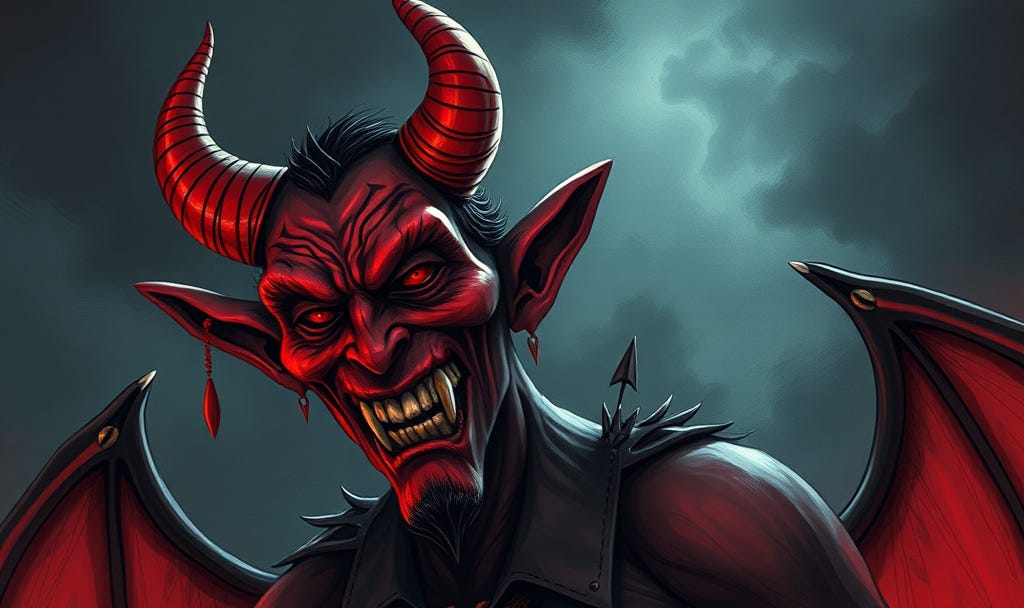
The Devil: A Biography and Spiritual History
Or: How a Minor Civil Servant in Heaven Built the Most Successful Personal Brand in History
Introduction: The Most Misunderstood Employee in Cosmic HR
Few figures in the human imagination have enjoyed as long, lucrative, or sartorially flamboyant a career as the Devil. He has been a serpent, a goat, a fallen star, a Hollywood lawyer, a cat, a fly, a fiddler in Georgia, and — most recently — whoever’s running the algorithm that decides what plays next on your phone.
He is the only celebrity who has remained continuously famous since approximately 1500 BCE without ever giving an interview, releasing a memoir, or appearing on a podcast, although he is widely suspected of producing several of them.
What follows is an honest attempt at his biography: tracking him from anonymous middle-management angel to the horned, hoofed, monocled gentleman of Western imagination, and finally to his current role as a flexible metaphor for whatever annoys us most. It is, by necessity, a story of theology, mistranslation, politics, art, and the deep human need to have someone other than ourselves to blame.
Part I: Before He Was Famous
The Hebrew Bible: The Adversary as Office Pest
Contrary to four millennia of pious assumption, the Devil does not appear in the opening chapters of the Bible. The serpent in Genesis 3 is just a serpent — described as “more crafty than any other beast of the field,” with no horns, no fire, and no Faustian bargain on offer. It is only later interpretation that retrofitted him into the role.[^1]
The Hebrew word ha-satan means, simply, “the adversary” or “the accuser” — a definite article followed by a job title, like “the bailiff.” In the Book of Job, ha-satan is one of the bene ha-elohim (sons of God) who appears in the heavenly court and proposes, with what reads as managerial concern, that perhaps Job’s piety should be stress-tested. God agrees with disturbing alacrity. The resulting bet — in which a faithful man loses his children, livestock, and skin — is theologically uncomfortable enough that subsequent traditions have spent two thousand years trying to relocate the moral responsibility somewhere, anywhere, else.[^2]
The point is that ha-satan in the Hebrew Bible is not a fallen rebel. He is something closer to a divine prosecutor: cynical, perhaps, but employed. Heaven, on this reading, runs less like an absolute monarchy and more like a slightly dysfunctional civil service.
Lucifer: The Career-Ending Translation Error
The transformation of Satan from “the prosecutor” into “the Devil” begins, as so many disasters do, with a Latin homework assignment.
Isaiah 14:12 contains a taunt aimed at the King of Babylon: “How art thou fallen from heaven, O Day Star, son of Dawn!” The Hebrew is helel ben shahar — “shining one, son of dawn” — a poetic insult comparing the king to the planet Venus, which rises brilliantly only to be extinguished by the sun. When Jerome translated this into Latin in the 4th century CE for the Vulgate, he rendered helel as Lucifer (”light-bringer”), the standard Latin name for Venus.[^3]
This was a perfectly competent translation. The disaster came when later Christian readers, having forgotten that the passage was about a Babylonian king and assuming Scripture never wasted a metaphor, decided “Lucifer” must be the personal name of the Devil before his fall. Thus the most powerful name in Christian demonology comes from a misreading of an astronomy reference in a piece of geopolitical sass. The Devil owes his most evocative title to a clerical error.
Persia: Where the Devil Got His Job Description
The serious upgrade to satanic infrastructure came not from Israel but from Persia. Zoroastrianism, founded by the prophet Zarathustra somewhere in the second millennium BCE, proposed a cosmos divided between Ahura Mazda, the Wise Lord of light, and Angra Mainyu (later Ahriman), the Destructive Spirit. They were locked in genuine cosmic combat, and human beings were obliged to take a side.[^4]
When the Persians conquered Babylon in 539 BCE and freed the Jewish exiles, this dualistic cosmology slipped quietly into Jewish thought. By the time of the Second Temple, Jewish writers were imagining a great spiritual war featuring named angels, named demons, and an embattled God whose victory was assured but not yet delivered. The intertestamental literature — 1 Enoch, Jubilees, the Dead Sea Scrolls — bristles with figures named Belial, Mastema, Azazel, and Semjaza, fallen Watchers who taught humans cosmetics, weaponry, and astrology, which the texts present as roughly equivalent crimes.[^5]
By the time Jesus arrives in the Gospels, Satan is no longer a member of the heavenly court. He has been promoted, against his will, to chief executive of an opposing firm.
Part II: The Christian Devil Goes Corporate
The New Testament: Satan Gets a Marketing Department
The Synoptic Gospels open Jesus’s ministry with a desert temptation scene that establishes Satan as a credible negotiating partner — he can apparently offer “all the kingdoms of the world,” suggesting either remarkable property holdings or remarkable nerve. Paul refers to him casually as “the god of this age” (2 Corinthians 4:4), a phrase Christian theology has been awkwardly clarifying ever since.[^6]
The Book of Revelation supplies the crucial visual: a “great red dragon” with seven heads and ten horns, identified as “that ancient serpent, who is called the Devil and Satan, the deceiver of the whole world” (Revelation 12:9). At a stroke, John of Patmos welds together the Genesis serpent, the Hebrew accuser, the Persian destroyer, and a piece of apocalyptic monster design, and the Devil emerges from the fusion fully formed, as if from a committee that finally agreed on something.[^7]
The Church Fathers: Theology by Whiteboard
The early Church Fathers, faced with a Devil who was now both Scripture and folklore, set about giving him a coherent backstory. Origen of Alexandria (c. 185–254 CE) proposed that Lucifer had been the highest of the angels and had fallen through pride — the original middle-manager who thought he should be running the place. Augustine of Hippo (354–430) refined the architecture: Satan fell before the creation of humanity, which is why he was hanging around in Eden looking for something to do.[^8]
Augustine also bequeathed to Western Christianity the doctrine that the Devil could not create, only corrupt — a useful theological move that allowed God to remain the sole architect of being while explaining why being so often tasted of disappointment. This doctrine has had the side benefit of making the Devil, theologically speaking, the most prolific plagiarist in history.
Medieval Europe: Branding Triumphs
The medieval period is when the Devil’s image consultants really earned their pay.
The horns came from Pan and other pre-Christian horned gods, demoted to demons under the rule that any deity who lost the theological argument retained his livestock features.[^9] The cloven hooves were Pan’s contribution as well. The pitchfork was originally a tool of the Greek god Poseidon, repurposed as a torture implement, presumably because nobody in the Middle Ages had a better idea for what to do with farm equipment in eternity. The red skin appears to derive from the colour of medieval theatrical costuming for fire and from association with the planet Mars. The bat wings replaced the original angelic feathers because feathers, having connotations of doves and the Holy Spirit, were felt to be insufficiently menacing.
By the 13th century the Devil had also acquired a substantial bureaucracy. The 1577 Pseudomonarchia Daemonum of Johann Weyer lists sixty-nine principal demons with ranks (Duke, Marquis, President, Count) and specialities, as if Hell were organised along the lines of the Holy Roman Empire, only with a clearer chain of command.[^10] Later the Lesser Key of Solomon expanded the roster to seventy-two, each with a sigil, a planetary hour, and a job. Astaroth taught the liberal sciences. Buer healed the sick (a bewildering job for a demon). Dantalion knew the thoughts of all men. Marbas could turn a man into any other shape, which seems both impressive and underused.
The medieval Devil was, in short, a fully unionised enterprise.
Hell Gets Its Architecture
The geography of Hell received its definitive treatment from Dante Alighieri in the Inferno (c. 1308–1320), which imagined the underworld as a nine-circle cone-shaped pit with Satan, gigantic and three-faced, frozen up to his waist in ice at the bottom.[^11] This was a striking innovation: previous Hells had been hot. Dante’s Devil, immobile, weeping, eternally chewing three of history’s worst traitors (Judas, Brutus, and Cassius), is a figure of crushing tedium rather than active malice — a portrait of evil as the cosmic equivalent of being stuck on hold.
It is one of the great aesthetic achievements of the human imagination, and it is mostly Dante’s invention. Scripture is essentially silent on Hell’s floor plan.
Part III: The Devil in Other Traditions
Islam: Iblis, the Dignified Refusenik
Islam offers a Devil with rather more philosophical interest than his Christian counterpart. In the Qur’an, Iblis (or Shaytan) is a jinn — a being of smokeless fire — who refuses God’s command to bow before the newly created Adam. His grounds are theologically stubborn: he was made of fire, Adam of clay, and he will not prostrate himself before an inferior substance.[^12] God, unimpressed by this combustion-based snobbery, expels him.
What makes Iblis interesting is his intelligence. Some Sufi mystics, notably al-Hallaj (858–922) and Ahmad al-Ghazali, read him almost sympathetically: as the only true monotheist, who would not bow to any creature, even on God’s orders, and who took eternal damnation rather than commit what he saw as idolatry.[^13] This reading is heretical, sublime, and very Sufi. Al-Hallaj, who held it among other things, was tortured and executed. The Devil, evidently, was not the only one with managerial difficulties.
Buddhism: Mara, the Demon of Distraction
Buddhism’s Devil-figure is Mara, who tempted Siddhartha Gautama under the Bodhi tree by deploying his three daughters — Tanha (Craving), Arati (Aversion), and Raga (Passion) — and an army of demons. The Buddha touched the earth as his witness, and Mara fled.[^14]
Mara is less a cosmic enemy than a personification of distraction itself: the inner voice that whispers, during meditation, that you have probably left the iron on. He is, in this respect, the most psychologically modern of all the world’s devils, and the only one with a clear use case.
Other Traditions: A Brief Inventory
Hindu cosmology features asuras — beings who are not exactly devils, more like rival deities who failed to make the cut, locked in eternal conflict with the devas. They occasionally win, which is theologically gracious of the system.
Norse mythology offers Loki, who is technically a god but whose career trajectory — childbirth via horse, tying a goat to his testicles, ultimate role in the apocalypse — earns him an honorary place on the list. He is the Devil as comedian, which is arguably the most accurate version.
Ancient Egyptian religion had Set, god of storms, deserts, foreigners, and bad moods, who murdered his brother Osiris. Set was not always a villain — earlier dynasties worshipped him sincerely — but later theology demoted him. He is a useful reminder that today’s god is tomorrow’s demon, depending entirely on which empire wins.
Part IV: The Devil in the Modern Imagination
The Reformation: Now With More Devils
The Protestant Reformation, which one might have expected to streamline supernatural bureaucracy, in fact produced one of the great demonic booms in history. Martin Luther threw inkpots at the Devil in the Wartburg Castle and reported that Satan visited him often, principally to argue theology and break wind.[^15] (Luther’s Devil is enthusiastically scatological. So is Luther.)
The early modern period saw the witch-hunts, in which an estimated 40,000 to 60,000 people, mostly women, were executed across Europe and colonial America between roughly 1450 and 1750, on the grounds that they had signed contracts with the Devil. The Malleus Maleficarum of 1486 — a manual so misogynistic and procedurally unhinged that the Catholic Church initially condemned it — became the bestselling book in Europe after the Bible.[^16] The Devil, it turned out, was excellent for circulation.
Milton: The Devil Gets a Speaking Role
In 1667, John Milton published Paradise Lost, and the Devil acquired, for the first time, an unforgettable voice. Milton’s Satan is magnificent: eloquent, wounded, defiant, the author of the line “Better to reign in Hell, than serve in Heaven” — which has been quoted approvingly by approximately every teenager since.[^17]
William Blake later observed that Milton “was of the Devil’s party without knowing it,” meaning that Milton had given the bad guy all the good lines.[^18] This is a real problem, and it inaugurates a long Romantic tradition in which Satan becomes a freedom fighter, a Promethean rebel, and finally — in Mary Shelley, Byron, and the Goethean Faust — something dangerously close to a hero.
The Faustian Bargain
The figure of Faust, scholar who sells his soul to Mephistopheles in exchange for knowledge and worldly pleasure, gave Western literature its great recurring metaphor for ambition’s price. Christopher Marlowe’s Doctor Faustus (c. 1592) damns him; Goethe’s Faust (1808/1832) saves him on the grounds of striving and the intervention of pretty angels who throw rose petals at the demons until they become embarrassingly aroused, which is a good summary of Goethe’s project generally.[^19]
The Faustian bargain has since become a stock metaphor, deployed against everyone from Wall Street bankers to Tesla shareholders. Mephistopheles, meanwhile, has settled into being the most articulate of all literary devils — a sort of divine sceptic who finds humans simultaneously contemptible and fascinating.
The Decline and Reinvention of the Devil
By the 19th century, theology was retreating and the Devil was retreating with it. The Enlightenment had little patience for personal demons, and the Romantic recasting of Satan as antihero further drained him of menace.
Charles Baudelaire wrote in 1864: “The cleverest ruse of the Devil is to convince you that he does not exist.” This line, in various forms, has become the unofficial motto of modern demonology, recycled most famously by Verbal Kint in The Usual Suspects (1995).[^20] It captures the modern condition: the Devil as cultural mascot rather than active personnel, more present in branding than in liturgy.
The 20th century gave the Devil a peculiar second wind. C.S. Lewis’s Screwtape Letters (1942) re-imagined him as a senior bureaucrat dispensing tactical advice to a junior tempter — a portrayal that anticipates the sense, common to anyone who has ever worked in an office, that evil is best understood as middle management.[^21] Mikhail Bulgakov’s The Master and Margarita (written 1928–1940, published 1966) brought Satan to Stalinist Moscow, where he turns out to be a relatively reasonable individual compared with the local literary establishment.[^22]
By 1968, Roman Polanski had given us Rosemary’s Baby; by 1973, William Friedkin had unleashed The Exorcist. Hollywood discovered that the Devil was reliable box office in a way that God was not, and has continued to cast him steadily, usually played by an actor with a good suit and an English accent.
Part V: The Devil Today
The contemporary Devil is, in one sense, defunct. Most mainline Protestant theology has quietly reduced him to a metaphor. Catholic theology officially retains him but rarely talks about him in public. Surveys repeatedly show belief in a literal Devil declining in the developed world, though it remains robust in the United States, where a 2023 Gallup poll found that around 58% of Americans believe the Devil exists — a higher proportion than believe in evolution.[^23]
In another sense, however, the Devil is everywhere. He has migrated from theology into idiom. We speak of “playing devil’s advocate,” “the devil in the details,” “deal with the Devil,” “between the Devil and the deep blue sea,” and “speak of the Devil” so often that we no longer notice the speech act we are performing. He is the patron saint of similes, the universal placeholder for whatever opposes us. He has been the face of heavy metal, the mascot of New Jersey hockey, and the punchline of countless cartoons in which a small horned figure perches on a shoulder and offers terrible, accurate advice.
He has also, perhaps inevitably, become a figure of reclamation. The Satanic Temple, founded in 2013, has used the Devil as a vehicle for legal activism, religious-freedom lawsuits, and reproductive-rights campaigning, on the strict understanding that they do not actually believe in him.[^24] This is the final twist: a Devil deployed in defence of Enlightenment values against the religious traditions that invented him. Somewhere, Iblis is taking notes.
Conclusion: The Mirror with Horns
If there is a single conclusion to be drawn from four thousand years of devil-watching, it is this: the Devil is, almost without exception, a reflection of the institution that defines him. The Hebrew prosecutor reflects a religion comfortable with cosmic argument. The Persian Ahriman reflects a religion that needed someone to lose the war. The Christian Lucifer reflects a Church that needed pride to be the original sin. The medieval bureaucrat-demon reflects a feudal hierarchy. Milton’s defiant Satan reflects a Puritan revolutionary’s ambivalence about his own revolution. The contemporary Devil — a metaphor, a brand, a bumper sticker — reflects a culture that has stopped believing in literal evil but cannot quite stop talking about it.
The Devil, in other words, has been the most patient and accurate biographer the human race has ever had. He has spent millennia recording, in the language of horns and fire, exactly what each civilisation found most frightening about itself. He may not, technically, exist. But the case for paying him close attention has never been stronger.
He is, after all, almost certainly listening.
Alan /|\
In this month’s MOOT we will dig a little deeper into Stans transformation from “adversary” tp Prince of Hell.
You might also be interested in my new book, The Devil, available on Amazon (Kindle and Softback)
References and Notes
[^1]: For the absence of Satan from the Eden narrative in its earliest Hebrew context, see Elaine Pagels, The Origin of Satan (Random House, 1995), pp. 35–62. Pagels traces the gradual identification of the Genesis serpent with Satan to post-biblical interpretation.
[^2]: The classic study of ha-satan as a courtroom function rather than a being is Peggy L. Day, An Adversary in Heaven: satan in the Hebrew Bible (Scholars Press, 1988). See also Henry Ansgar Kelly, Satan: A Biography (Cambridge University Press, 2006), chapters 1–3.
[^3]: Jerome, Vulgate, Isaiah 14:12. On the translation history, see Jeffrey Burton Russell, Lucifer: The Devil in the Middle Ages (Cornell University Press, 1984), pp. 192–193. The conflation of Isaiah’s Babylonian king with the Devil is principally a development of patristic and later medieval exegesis.
[^4]: Mary Boyce, Zoroastrians: Their Religious Beliefs and Practices (Routledge, 2nd ed., 2001), pp. 19–29. On the influence of Zoroastrian dualism on Second Temple Judaism, see Shaul Shaked, “Iranian Influence on Judaism” in Cambridge History of Judaism, vol. 1.
[^5]: 1 Enoch 6–11 contains the foundational “Watchers” narrative. See George W. E. Nickelsburg, 1 Enoch 1: A Commentary (Fortress Press, 2001). The Dead Sea Scrolls’ War Scroll (1QM) sets out the cosmic dualism between the Sons of Light and the Sons of Darkness.
[^6]: 2 Corinthians 4:4. On New Testament demonology generally, see Susan R. Garrett, The Demise of the Devil(Fortress Press, 1989).
[^7]: Revelation 12:9. For analysis of the imagery’s roots in ancient Near Eastern combat myth, see Adela Yarbro Collins, The Combat Myth in the Book of Revelation (Westminster, 1976).
[^8]: Augustine, City of God, Book XI, chapters 11–13. Origen’s speculations on the pre-cosmic fall appear in De Principiis, Book I.
[^9]: On the demonisation of pre-Christian deities, see Ronald Hutton, The Triumph of the Moon (Oxford University Press, 1999), pp. 32–43, and Jeffrey Burton Russell, The Devil: Perceptions of Evil from Antiquity to Primitive Christianity (Cornell University Press, 1977).
[^10]: Johann Weyer, Pseudomonarchia Daemonum, appended to De praestigiis daemonum (1577). For the Lesser Key of Solomon and its 72 demons, see The Goetia: The Lesser Key of Solomon the King, ed. Aleister Crowley and S.L. MacGregor Mathers (1904).
[^11]: Dante Alighieri, Inferno, Canto XXXIV. On Dante’s invention of Hell’s geography, see Alison Morgan, Dante and the Medieval Other World (Cambridge University Press, 1990).
[^12]: Qur’an 7:11–18, 15:26–43, 38:71–85. For comparative analysis, see Peter J. Awn, Satan’s Tragedy and Redemption: Iblis in Sufi Psychology (Brill, 1983).
[^13]: On al-Hallaj’s sympathetic Iblis, see Louis Massignon, The Passion of al-Hallaj (Princeton University Press, 1982 trans.), vol. 3. Awn (above) treats Ahmad al-Ghazali’s parallel position.
[^14]: The defeat of Mara is recounted in numerous early Buddhist texts including the Padhana Sutta of the Sutta Nipata. See Trevor Ling, Buddhism and the Mythology of Evil (Allen & Unwin, 1962).
[^15]: Heiko A. Oberman, Luther: Man Between God and the Devil (Yale University Press, 1989), pp. 155–157, on Luther’s persistent and remarkably visceral encounters with Satan.
[^16]: Heinrich Kramer, Malleus Maleficarum (1486). For the witch trials’ scope and the Malleus‘s influence, see Brian P. Levack, The Witch-Hunt in Early Modern Europe (Routledge, 4th ed., 2015), pp. 21–24, on execution estimates.
[^17]: John Milton, Paradise Lost, Book I, line 263.
[^18]: William Blake, The Marriage of Heaven and Hell (1790–1793), plate 6.
[^19]: Christopher Marlowe, The Tragical History of Doctor Faustus (c. 1592, A-text 1604, B-text 1616). Johann Wolfgang von Goethe, Faust, Part I (1808) and Part II (1832). For the rose petal scene, see Faust Part II, Act V.
[^20]: Charles Baudelaire, “Le Joueur généreux,” Le Figaro, 7 February 1864, collected in Le Spleen de Paris (1869). The line was given iconic film expression in The Usual Suspects, dir. Bryan Singer, screenplay by Christopher McQuarrie (1995).
[^21]: C.S. Lewis, The Screwtape Letters (Geoffrey Bles, 1942).
[^22]: Mikhail Bulgakov, The Master and Margarita, written 1928–1940, first published in censored form in Moskvamagazine, November 1966 – January 1967.
[^23]: Gallup, “Belief in Five Spiritual Entities Edges Down to New Lows,” 20 July 2023, https://news.gallup.com/poll/508886/belief-five-spiritual-entities-edges-down-new-lows.aspx.
[^24]: Joseph P. Laycock, Speak of the Devil: How The Satanic Temple is Changing the Way We Talk about Religion(Oxford University Press, 2020).
"The Devil is, almost without exception, a reflection of the institution that defines him" is the sentence this whole survey was building toward, and it happens to be the same argument I keep making across a lot of very different traditions lately, just delivered with more scholarship behind it.
Mara gets singled out correctly as "the only one with a clear use case" because he's the one tradition that never bothered dressing distraction up as an external army. Three daughters and some bad advice during meditation is a much more honest description of what actually derails most people than horns and a pitchfork ever were.
But dissolving him into metaphor doesn't actually kill him, it just proves the thesis. A being who only ever existed as whatever a given institution needed him to represent was never going to need to be literally real to keep doing his job.