
Occultism 101
So, you want to be an Occultist?

Beyond the Veil: The True Path of Occultism and Personal Transformation
Introduction: Reclaiming a Misunderstood Tradition
The word “occult” conjures images in the popular imagination: dark robes, sinister rituals, deals with demons, and malevolent powers wielded by shadowy figures. Hollywood has profited handsomely from this mythology, while romantic notions have painted occultists as either villains trafficking with darkness or rebels wielding forbidden powers. Yet the reality of occultism—the Western esoteric tradition—could not be further from these caricatures.
The word “occult” literally means “hidden,” referring not to something sinister but to knowledge that remains concealed from the practitioner until they can properly comprehend it. This is not about black magic or supernatural horrors. It is about personal magic: the disciplined transformation of consciousness, the discovery of one’s true nature, and the development of spiritual capacities through systematic practice.
Modern occultism emerged in 19th-century France through figures like Éliphas Lévi, who sought to reconcile science and religion by reviving ancient esoteric wisdom. Scholar Wouter J. Hanegraaff has defined occultism as Western esoteric traditions attempting to “come to terms with a disenchanted world”—a world where scientific materialism had stripped away the sense of mystery and meaning.
This article delves into the true meaning of becoming an occultist, examining the research, reading, and practical exercises that comprise this demanding yet transformative path of personal development.
The Western Esoteric Tradition: A Historical Overview
To understand occultism, we must first understand its roots in the broader Western esoteric tradition, a complex tapestry woven from diverse philosophical and spiritual threads.
Ancient Foundations
The earliest traditions of Western esotericism originated in the Eastern Mediterranean during Late Antiquity, where Hermeticism, Gnosticism, and Neoplatonism emerged as distinct schools of thought, diverging from mainstream Christianity. These ancient systems emphasised direct spiritual experience, the divine nature of humanity, and the existence of hidden knowledge accessible through spiritual development rather than faith alone.
Renaissance Revival
Renaissance Europe witnessed a growing interest in these older ideas, as intellectuals combined pagan philosophies with Kabbalah and Christian philosophy, giving rise to movements such as Christian Kabbalah and Christian theosophy. Giovanni Pico della Mirandola argued for a grand universal wisdom underlying all philosophical traditions—an idea that would become central to occult thought.
Heinrich Cornelius Agrippa’s “De occulta philosophia libri tres” used Christian Kabbalah as a framework to explore philosophical and scientific traditions of antiquity, establishing a methodology that would influence occultists for centuries.
The 19th Century Occult Revival
The 19th century marked a watershed moment. The Societas Rosicruciana in Anglia, the Theosophical Society, and the Hermetic Order of the Golden Dawn emerged as significant groups synthesising various esoteric currents. Éliphas Lévi, sometimes called the “founder of occultism,” wrote about a purported ancient and universal tradition of spiritual wisdom in his influential work “Dogme et rituel de la haute magie”.
Rather than accepting “the triumph of scientism,” occultists sought “an alternative solution,” trying to integrate “scientific progress or modernity” with “a global vision”. They weren’t rejecting science but seeking a framework that honoured both empirical investigation and spiritual experience.
What Occultism Is—and Isn’t
Before exploring the path of becoming an occultist, we must dispel persistent misconceptions.
Not Black Magic
The association of occultism with “black magic” is perhaps the most damaging misconception. The supernatural “ooky spooky stuff” people associate with occultism is not occult—it’s just plain old spooky. Genuine occultism focuses on spiritual development, self-knowledge, and the cultivation of consciousness.
Yes, grimoires like the Lesser Key of Solomon exist within the tradition, but even these are better understood as psychological and spiritual technologies rather than literal demon-summoning manuals. Later occultists saw entities described in grimoires as aspects of the psyche rather than literal demons.
About Personal Transformation
A defining characteristic of modern occultists was “the emphasis they placed on ‘the spiritual realisation of the individual’”—an idea that would profoundly influence both the New Age movement and the Human Potential Movement of the 20th century.
The occult path is fundamentally about:
Self-knowledge: Understanding the depths of one’s own consciousness
Spiritual development: Cultivating latent capacities through disciplined practice
Personal transformation: Becoming who you truly are, rather than who conditioning has made you
Integration: Synthesising knowledge from multiple traditions into a coherent practice
A Middle Way Between Science and Religion
Éliphas Lévi viewed magic as occupying a space between science and religion, believing it had the potential to serve as a conciliatory or mediating function. This remains central to occult philosophy: it neither demands blind faith nor reduces everything to material mechanisms, but seeks experiential knowledge through systematic practice.
Key Texts and Thinkers
The occult tradition has produced a vast literature. For the aspiring occultist, certain works stand as essential foundations.
Éliphas Lévi: The Foundation
“Dogme et Rituel de la Haute Magie” (1854-1856) established Lévi’s philosophical approach to magic, detailing methods of accessing esoteric knowledge through supernatural means while chronicling the history of magic, including alchemy, astrology, and divination.
Lévi rejected the view that magic or religion is inherently irrational, instead positing magic as an “esoteric science” and suggesting that Hermeticism could be adapted to uncover the underlying truth behind all magical systems. This comparative approach anticipated the development of modern religious studies.
Lévi’s work introduces fundamental concepts: the importance of will, the doctrine of correspondences (as above, so below), the role of symbolism, and the necessity of moral and spiritual preparation before attempting magical practice.
Dion Fortune: Practical Psychology Meets Occultism
Dion Fortune (1890-1946), founder of The Society of the Inner Light, is recognised as one of the most luminous figures of twentieth-century esoteric thought. A prolific writer, pioneer psychologist, powerful psychic, and spiritualist who dedicated her life to the revival of the Western Mystery Tradition.
Her essential works include:
“Psychic Self-Defense” (1930): This book presents a clear, practical manual for recognizing, understanding, and protecting oneself from hostile psychic influences, blending case anecdotes, psychological insight, and ritual techniques. It addresses a critical but often overlooked aspect of occult work: maintaining psychological and spiritual boundaries.
“The Mystical Qabalah”: This remains one of the clearest expositions of the Qabalistic system for Western practitioners, explaining the Tree of Life and its practical applications for spiritual development.
“The Training and Work of an Initiate” (1930): A practical guide to occult development that addresses the real challenges practitioners face.
Fortune’s unique contribution was her integration of depth psychology with traditional occult practices. Her interest in psychoanalysis and attraction toward the occult stemmed from their apparent overlap, and she demonstrated how psychological understanding could illuminate esoteric practices—and vice versa.
Aleister Crowley: The Scientific Approach to Magick
Aleister Crowley (1875-1947) remains one of the most controversial yet influential figures in modern occultism. While not always the nicest person—scandals and drama followed him, along with numerous love affairs and accusations of demon worship—his impact on modern occultism was profound.
“Magick: Book 4” (Liber ABA): Widely considered Crowley’s magnum opus, this lengthy treatise synthesises yoga, Hermeticism, medieval grimoires, and contemporary magical theories with his own original contributions.
The book is divided into four parts: Mysticism (meditation and yogic training), Magick Elementary Theory (principles and definitions), Magick in Theory and Practice (rituals, tools, and applications), and ΘΕΛΗΜΑ—The Law (dealing with The Book of the Law).
The Book of the Law (Liber AL vel Legis): Received in 1904, this concise text serves as the foundation of Thelema, Crowley’s philosophical and spiritual system. Its central axioms—” Do what thou wilt shall be the whole of the Law” and “Love is the law, love under will”—are often misunderstood. They’re not licenses for hedonism but profound statements about discovering and following one’s True Will: the deepest, most authentic purpose of one’s existence.
Crowley defined magick as “the Science and Art of causing Change to occur in conformity with Will”—neither superstition nor escapism, but disciplined, experimental pursuit of mastery over the self and one’s environment through awakening divine potential.
Crowley emphasised that each individual should follow their own inherent “True Will” rather than blindly following his teachings, saying he did not wish to found a flock of sheep. This anti-authoritarian stance is essential to understanding his work.
For contemporary readers, “Living Thelema: A Practical Guide to Attainment in Aleister Crowley’s System of Magick” by David Shoemaker provides an accessible entry point, focusing on practical and experiential aspects without requiring immersion in Crowley’s often difficult writing style.
Other Essential Works
“777 and Other Qabalistic Writings of Aleister Crowley”: A reference work of correspondences essential for understanding symbolic systems.
Israel Regardie’s “The Golden Dawn”: The most complete published account of the Hermetic Order of the Golden Dawn’s teachings and rituals, providing a systematic approach to ceremonial magic.
Arthur Edward Waite’s works: Though more mystically inclined than magically focused, Waite’s writings on the Tarot, Kabbalah, and ceremonial magic provide valuable historical and philosophical context.
The Process of Becoming an Occultist
Becoming an occultist is not a matter of reading a few books or performing occasional rituals. It requires dedication, discipline, and a willingness to undertake genuine inner transformation.
Here’s a suggested syllabus for study, based on conversations with real, rather than social media-informed, occultists.
Phase One: Study and Foundation (Years 1-2)
Reading and Research
You can begin with historical and philosophical foundations before you dive into practice. Understanding the origins of occultism and its true meaning prevents misunderstandings and missteps.
Essential early reading:
General histories of Western esotericism
Biographical accounts of major figures
Introductory texts that provide overview rather than detailed instruction
Works on comparative religion and mythology
Establishing a Meditation Practice
Crowley’s system of yoga is designed to still the mind and enable single-pointed concentration, borrowing heavily from practitioners like Patanjali while jettisoning much attendant moral dogma. Every occult tradition emphasizes meditation as foundational.
Begin with simple practices:
Daily sitting meditation (start with 10-15 minutes)
Breath awareness exercises
Concentration practices (focusing on a single object)
Mindfulness in daily activities
Keeping a Magical Diary
From the beginning, maintain a detailed record of your studies, practices, dreams, and experiences. This diary becomes essential for tracking progress, identifying patterns, and refining your practice.
Phase Two: Basic Practical Work (Years 2-4)
Ritual Practice
Begin with foundational rituals:
The Lesser Banishing Ritual of the Pentagram (LBRP): This basic ritual establishes sacred space, banishes unwanted influences, and cultivates presence. It should be practised daily.
Middle Pillar Exercise: This practice works with the body’s energetic centres, cultivating awareness of subtle energies.
Regular devotional or invocatory work: Establishing a relationship with particular deities, forces, or aspects of consciousness through prayer, invocation, or meditation.
Study of Symbolic Systems
Deepen understanding of:
The Qabalah and Tree of Life
Tarot symbolism and divination
Astrology
Alchemy (both symbolic and practical)
Sacred geometry
These aren’t separate subjects but different lenses for viewing the same underlying patterns of consciousness and cosmos.
Energy Work and Subtle Bodies
Develop sensitivity to subtle energies through:
Visualization exercises
Energy sensing practices
Work with the chakra or sephirotic systems
Grounding and shielding techniques
Fortune emphasised disciplined mental hygiene, shielding practices, and focused ritual work to restore balance and safety—capabilities developed through consistent practice.
Phase Three: Deepening Practice (Years 4-7)
Advanced Ritual Work
Progress to more complex operations:
Planetary rituals and invocations
Pathworking (visionary journeys through symbolic landscapes)
Talismanic magic
Ceremonial operations requiring extensive preparation
Working with Ordeals and Challenges
The occult path inevitably brings challenges:
Confronting shadow aspects of the psyche
Periods of apparent stagnation or “dark nights”
Destabilisation of previous identity structures
Relationship difficulties as your practice creates distance from consensus reality
These aren’t failures but necessary stages of development. Fortune herself experienced what she perceived as psychic attacks and psychic assault during her development, experiences that informed her later teachings.
Exploring Specialised Paths
As practice deepens, practitioners typically specialise:
Ceremonial magic
Mystical devotion
Hermetic philosophy
Practical theurgy
Alchemical work (internal or laboratory)
Divination arts
Phase Four: Integration and Service (Ongoing)
Living the Philosophy
Thelema involves physical, mental, and spiritual exercises aimed at uncovering one’s True Will and enacting change in alignment with it, including rituals, yoga, and meditation to explore consciousness and achieve self-mastery. The ultimate test is not what you can do in the temple but how you live your life.
Integration means:
Embodying occult principles in daily decisions
Applying esoteric wisdom to practical challenges
Maintaining regular practice while engaging fully with worldly life
Finding balance between the sacred and mundane
Teaching and Service
Many advanced practitioners feel called to share their knowledge, whether through:
Teaching students
Writing and publishing
Creating art inspired by esoteric principles
Working for social transformation
Organising collective magical work, as Fortune did during WWII, with her program of visualisation and meditation undertaken by people across the United Kingdom
Essential Practices: A Practical Summary
For those beginning the path, these practices form the core of occult development:
Daily Practices:
Morning meditation (20-30 minutes minimum)
LBRP or equivalent banishing/centring ritual
Magical diary entry
Study period (at least 30 minutes)
Evening meditation or devotional work
Weekly Practices:
More extensive ritual work
Divination practice
Energy work or body-based practices
Community engagement (if available)
Monthly Practices:
Extended retreat or intensive practice
Review of magical diary
Goal-setting and reflection
Ritual aligned with lunar or solar cycles
Ongoing Development:
Systematic study of one major text or tradition
Work with a teacher or group (when appropriate)
Regular assessment and refinement of practice
Physical health and psychological well-being maintenance
Common Misconceptions and Pitfalls
Pitfall 1: Seeking Power Rather Than Development
Those who approach occultism seeking power over others or external control inevitably fail. Crowley stated that his work used “the method of science; the aim of religion,” and that genuine powers of the magician could be objectively tested—but the “powers” worth developing are primarily internal: clarity, will, consciousness, and understanding.
Pitfall 2: Neglecting Psychological Health
Occult practice can destabilise psychological structures. Without adequate preparation and support, this can lead to a crisis rather than growth. Modern practitioners benefit from Fortune’s integration of occult practice with psychological understanding, and many find conventional therapy valuable alongside esoteric work.
Pitfall 3: Spiritual Bypassing
Using occult practice to avoid dealing with mundane problems—relationships, career, health, finances—undermines both ordinary life and spiritual development. True occultism integrates all levels of existence.
Pitfall 4: Excessive Eclecticism
While contemporary Thelemites may practice more than one religion and borrow freely from various traditions, including alchemy, astrology, qabalah, tantra, tarot, and yoga, beginners benefit from depth in one system before exploring breadth. Jumping between traditions without mastering any leads to confusion.
Pitfall 5: Isolation
While solitary practice has value, complete isolation can lead to imbalance. The development of initiatory societies like Rosicrucianism and Freemasonry, and later groups like the Golden Dawn, reflected the recognition that collective practice, teaching lineages, and community support are valuable—even essential—for many practitioners.
The Occult Path Today
Western esotericism has only emerged as a serious field of academic study in the late 20th century, pioneered by scholars like Frances Yates and Antoine Faivre. This academic interest has helped strip away sensationalism while revealing the genuine depth and sophistication of esoteric traditions.
Contemporary occultism takes many forms:
Traditional ceremonial magic orders
Chaos magic and postmodern approaches
Neo-pagan and witchcraft movements
Hermetic philosophy groups
Thelemic organizations
Independent practitioners synthesizing multiple traditions
The internet has made texts and teachings accessible that previously required years of searching or initiation into secret societies. This democratization has both benefits and challenges—access to information doesn’t replace the necessity of discipline, practice, and genuine transformation.
Conclusion: The True Magic
The true magic of occultism lies not in supernatural powers or dramatic phenomena, but in the systematic cultivation of consciousness, will, and understanding. It offers a path for those who refuse to accept either religious dogma or materialist reductionism, who seek direct experience of deeper realities through disciplined practice.
Occultism in the Western tradition is the study of hidden knowledge—knowledge kept from the wider population until proper preparation, knowledge that reveals itself gradually through practice, and knowledge that transforms the practitioner in the process of discovery.
This is not a path for the faint of heart or those seeking quick results. It demands years of dedicated practice, willingness to confront uncomfortable truths about oneself, and commitment to genuine transformation rather than theatrical display.
But for those who persist—who study deeply, practice diligently, and approach the work with both rigor and humility—occultism offers something precious: a systematic method for uncovering your true nature, developing latent capacities, and living with greater awareness, purpose, and authenticity.
The hidden knowledge is not hidden by others keeping secrets. It is hidden by the limitations of our ordinary consciousness. Occult practice removes those limitations, revelation by revelation, practice by practice, year by year, until what was once occult becomes manifest—not as external power, but as the transformed awareness that recognises its own divine nature.
This is the Great Work: not to become something you are not, but to fully become what you have always potentially been. That is the true magic—and it is available to anyone willing to undertake the journey.
Alan /|\
This months Moot
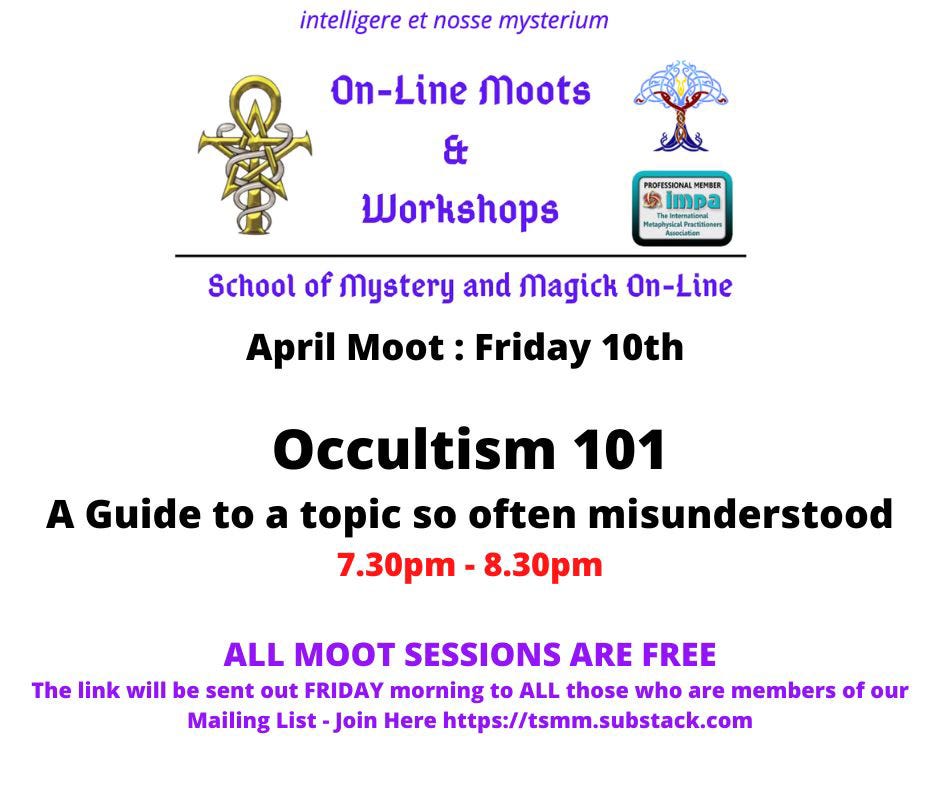
Details will be sent to subscribers of this list in the morning of the Moot.